
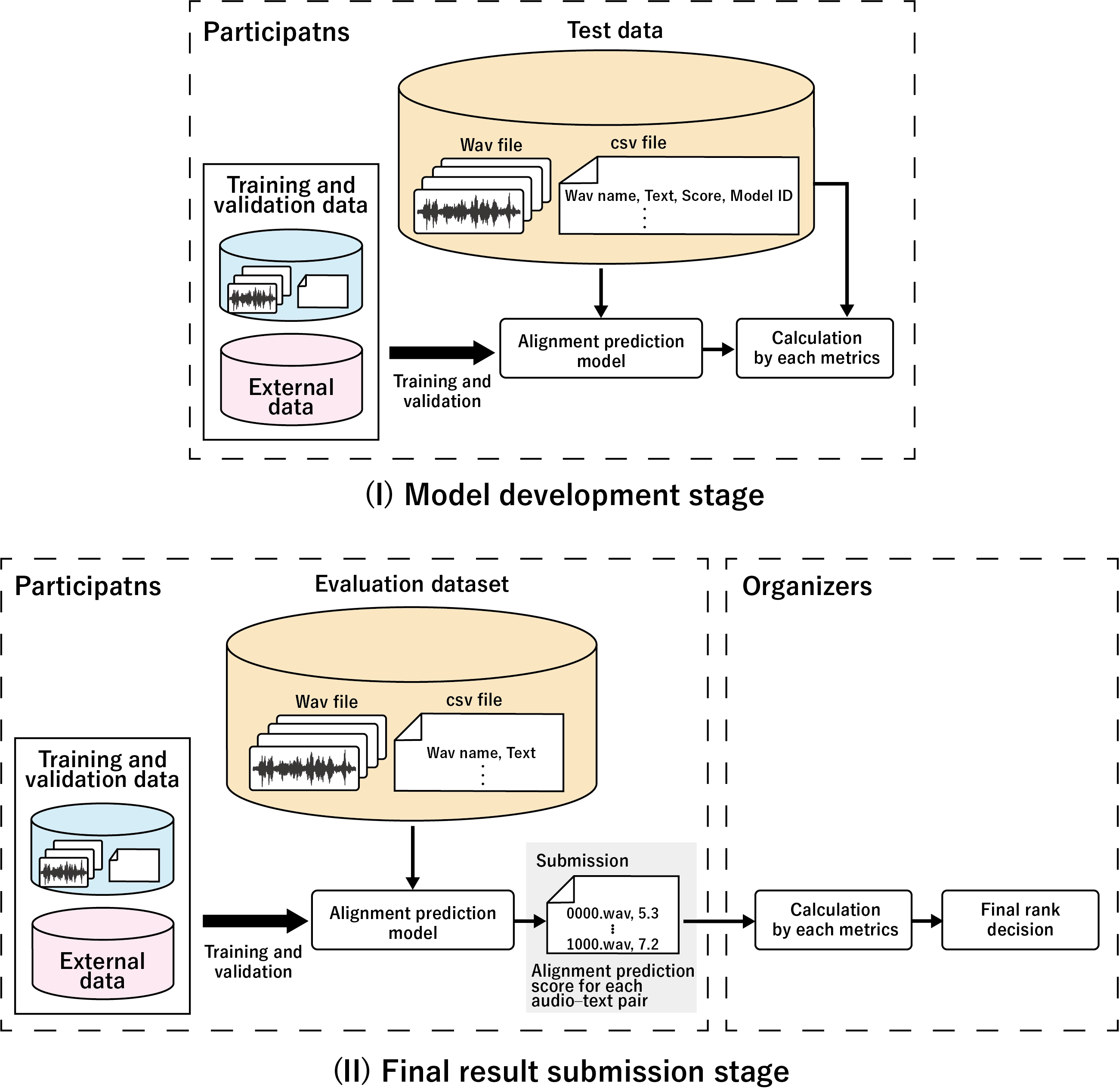
The scope of this challenge is to predict the semantic alignment of a given general audio and text pair. In a generative model, evaluating the alignment between input and output is extremely important. For instance, in the evaluation of text-to-audio generation (TTA), methods have been proposed to objectively evaluate the alignment between audio and text. However, these methods often show low correlation with human subjective evaluations. To address this issue, XACLE Challenge 2026 focused on developing semantic alignment prediction models that correlate highly with human subjective evaluations. In XACLE Challenge 2026, training and evaluation were conducted using audio generated by the same audio generation models. XACLE Challenge 2027 extends this setting to evaluate generalization to unseen audio generation models. Training is conducted using audio generated by a set of known models, while evaluation is conducted using audio generated by unseen models. The goal is to develop semantic alignment prediction models that maintain high correlation with human subjective evaluations even for audio generated by unseen audio generation models.

The training, validation, and test data consist of the following:
The evaluation dataset will be released on 19 November 2026.
The datasets and models listed below can be used without the approval of the organizers.
| Dataset or model name ▲ ▼ | Type ▲ ▼ | Added ▲ ▼ | Link | Note |
|---|
Submissions will be evaluated on the basis of the correlation coefficient and score error between predicted and average-semantic-alignment scores. Specifically, the metrics include the linear correlation coefficient (LCC), Spearman's rank correlation coefficient (SRCC), Kendall's rank correlation coefficient (KTAU), and mean squared error (MSE). When \(y\) represents the average-semantic-alignment scores and \(\hat{y}\) represents the predicted scores for each audio–text pair, the evaluation metrics are calculated as follows. \[ LCC = \frac{\sum(y - m_y)(\hat{y} - m_\hat{y})}{\sqrt{\sum(y-m_y)^2 \sum(\hat{y}-m_{\hat{y}})^2}}, \] where \(m_y\) and \(m_\hat{y}\) denote the mean of the vector \(y\) and \(\hat{y}\), respectively. \[ SRCC = 1 - \frac{6\sum d_i^2}{n(n^2 - 1)}, \] \[ d = rank(y) - rank(\hat{y}), \] where \(n\) and \(rank(\cdot)\) denote the number of sample and sorting by rank. If there are ties, the average rank is assigned to each of the tied values. \[ KTAU = \frac{N_c - N_d}{\sqrt{(N_c + N_d + N_{tx})(N_c + N_d + N_{ty})}}, \] where \(N_c\), \(N_d\), \(N_{tx}\), and \(N_{ty}\) denote the number of concordant pairs where the ranks of the predicted scores and average-semantic-alignment scores, discordant pairs, tied pairs for the x-axis variable, and tied pairs for the y-axis variable. \[ MSE = \frac{1}{N}\sum_{i=1}^{N}(y_i - \hat{y}_i)^2, \] where \(N\) denotes number of sample. The purpose of this challenge is to develop a method for automatic evaluation that correlates highly with human subjective evaluations. Therefore, we will use metrics that demonstrate correlations and differences from human evaluation scores. We will provide the source code for each evaluation metric on GitHub of the baseline model.
The final ranking is determined by the SRCC metric. If multiple teams are tied, the standings will be determined using the LCC, KTAU, and MSE metrics. The top five ranked submissions will be invited to submit a 2-page paper, with the accepted papers having the opportunity to be presented at ICASSP 2027.
The task organizers will provide a supervised score prediction model, similar to the baseline model of the RELATE and XACLE Challenge 2026 baseline model. The baseline model consists of an audio encoder, a text encoder, and two fully connected layers for score prediction. A pre-trained model is used for both the audio and text encoders. We will provide the source code of the baseline model on GitHub. If you use this code, cite the following papers.
For inquiries or questions, please send an email to contact@xacle.org.
